HR Tech
Enterprise SaaS

MY ROLE
Design
Dev Handoff
DURATION
6 weeks
TEAM
Product Owner
Tech Lead
CHALLENGE
A Diary Was the Only System
ZingHR's recognition system was a single point of failure locked inside one person's memory.
When I began researching the admin workflow, I had to navigate internal resistance just to identify who the admin was. The admin's identity was deliberately obscured within the company for security reasons. After escalating through HR and my manager, I finally spoke to the person who had been managing ZingHR's internal recognition system for 13 years.
What I found when I met him changed the entire direction of the project.
He acknowledged it himself: because he had been present when the structure was built, he could hold it all in his head. But if he left the company and someone had to replace him, a knowledge transfer using a phone calendar, a diary, and memory would be impossible.
This surfaced two distinct problems that the module needed to solve:
Admin-side problem
No structured system to track award timelines, nomination windows, deadlines, or responsible nominators across regions
The entire recognition operation was undocumented tribal knowledge, creating a critical single point of failure
If the admin left, the system would effectively collapse
Employee-side problem
Because awards had no visible structure or timeline, recognition felt arbitrary and random to employees
There was no clarity on how awards worked, who could nominate, or when decisions were made
Competitive problem
ZingHR had no formal R&R module while competitors including Darwinbox, Keka, Zoho, and GreytHR already had structured recognition features
This was creating a feature parity gap in sales conversations with enterprise customers
THE PROCESS
Research & Discovery
I started from scratch with a brief asking me to replicate how award functions work in a corporate setting. My research had two tracks.
Primary research
Tracked down and interviewed the admin directly after navigating internal resistance, discovering the diary and phone calendar system described above
Mapped the workflows of all five user roles to understand what each person needed from the system
Secondary research
Studied how real-world corporate award ceremonies and jury systems are structured
Conducted competitive analysis of Darwinbox, Keka, Zoho, and GreytHR to understand existing patterns and identify gaps
Key Design Decisions
Decision 1: The Award Calendar
The most important design decision in this project came directly from the admin interview. The phone calendar and diary were not just inconvenient tools. They were symptoms of a system with no structural home.
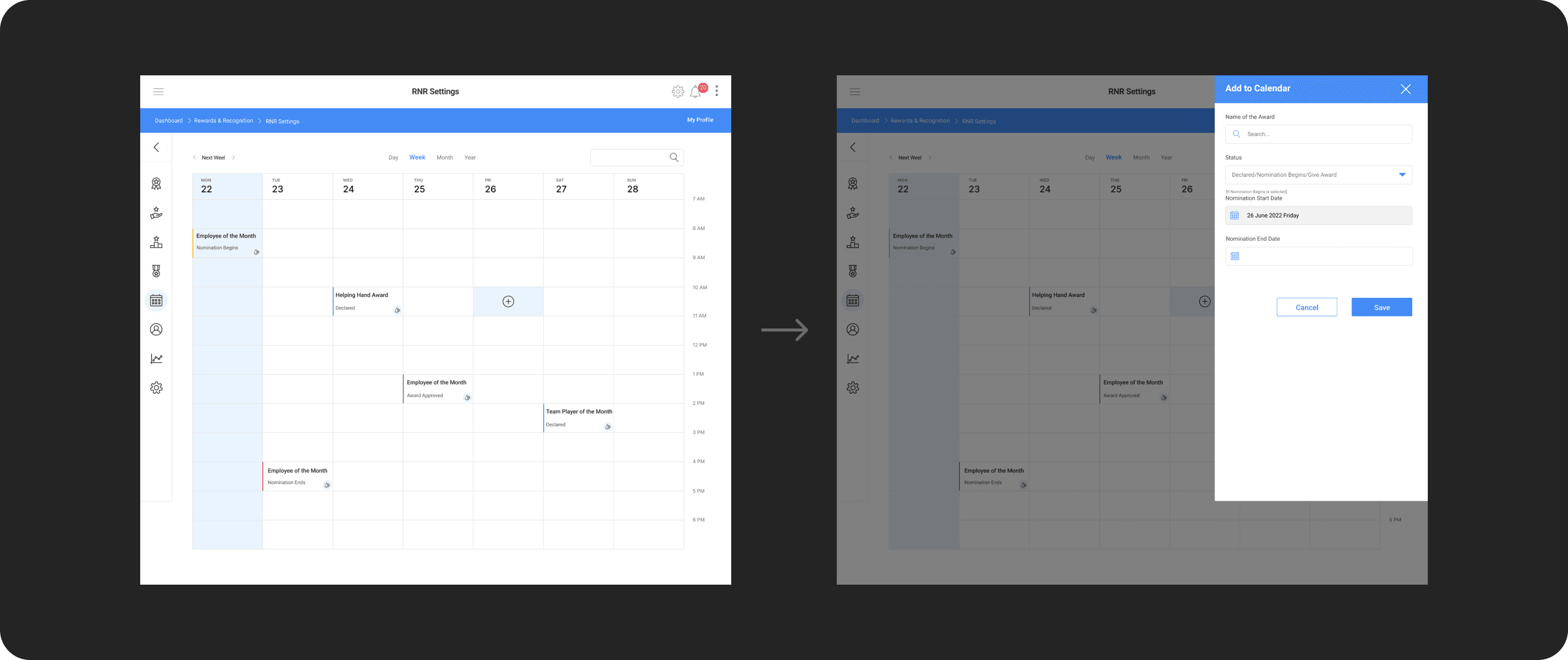
The Award Calendar converted undocumented institutional knowledge into a structured, transferable admin tool. Any future admin could pick up the system without a single knowledge transfer conversation. The calendar allowed admins to schedule all awards across all regions, set nomination start and end dates, assign nominators per award, and send reminders. What existed only in one person's memory could now be configured, visible, and repeatable.
Decision 2: The Jury Mental Model
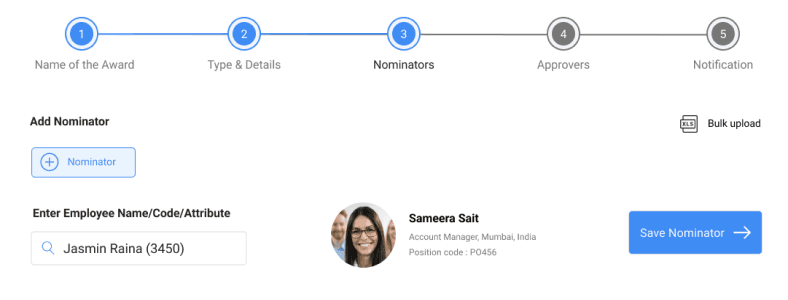
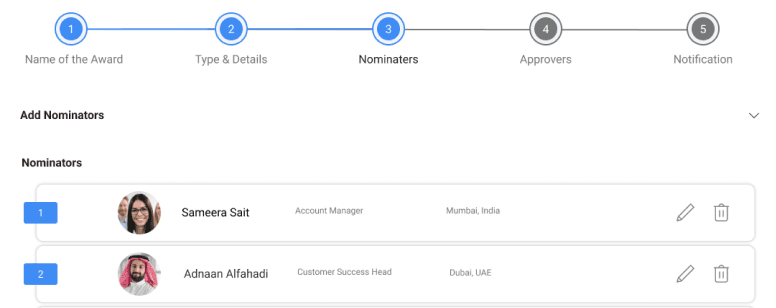
The most complex design challenge was making a multi-role permission system feel intuitive rather than arbitrary. The module had five award types, three levels of nominators, and a CHRO as the final approver. Without a clear mental model, this would have been confusing to configure and use.
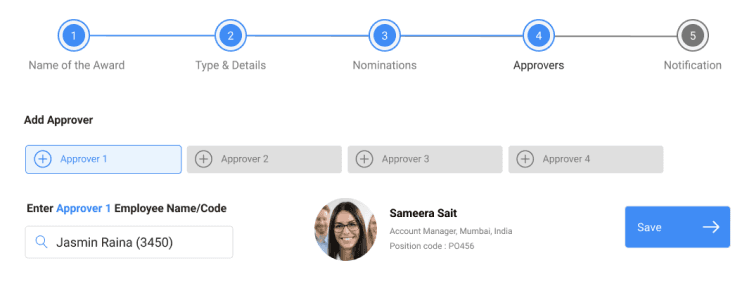
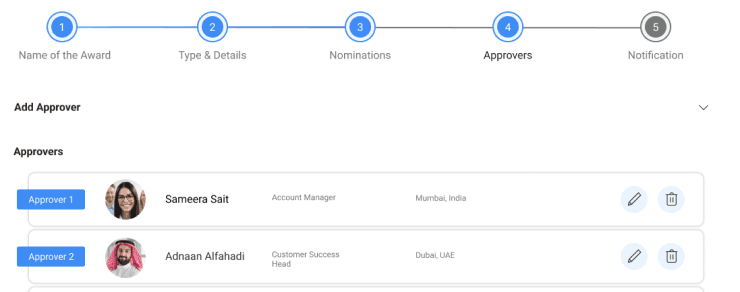
The solution came from the research into how real-world award ceremonies work. I mapped the entire permission structure onto a jury system that people already understood:
Managers, product owners, and heads of product act as preliminary judges who identify and nominate candidates within their scope
The CHRO acts as the final jury who makes the definitive call
This mental model made the hierarchy logical and grounded it in a real-world analogy rather than an abstract permission tree.

Decision 3: Group-Based Award Configuration
A key insight from the competitive analysis was that simpler R&R tools used flat org structures for award eligibility. For ZingHR's enterprise B2B customers with complex org hierarchies, this would not scale.
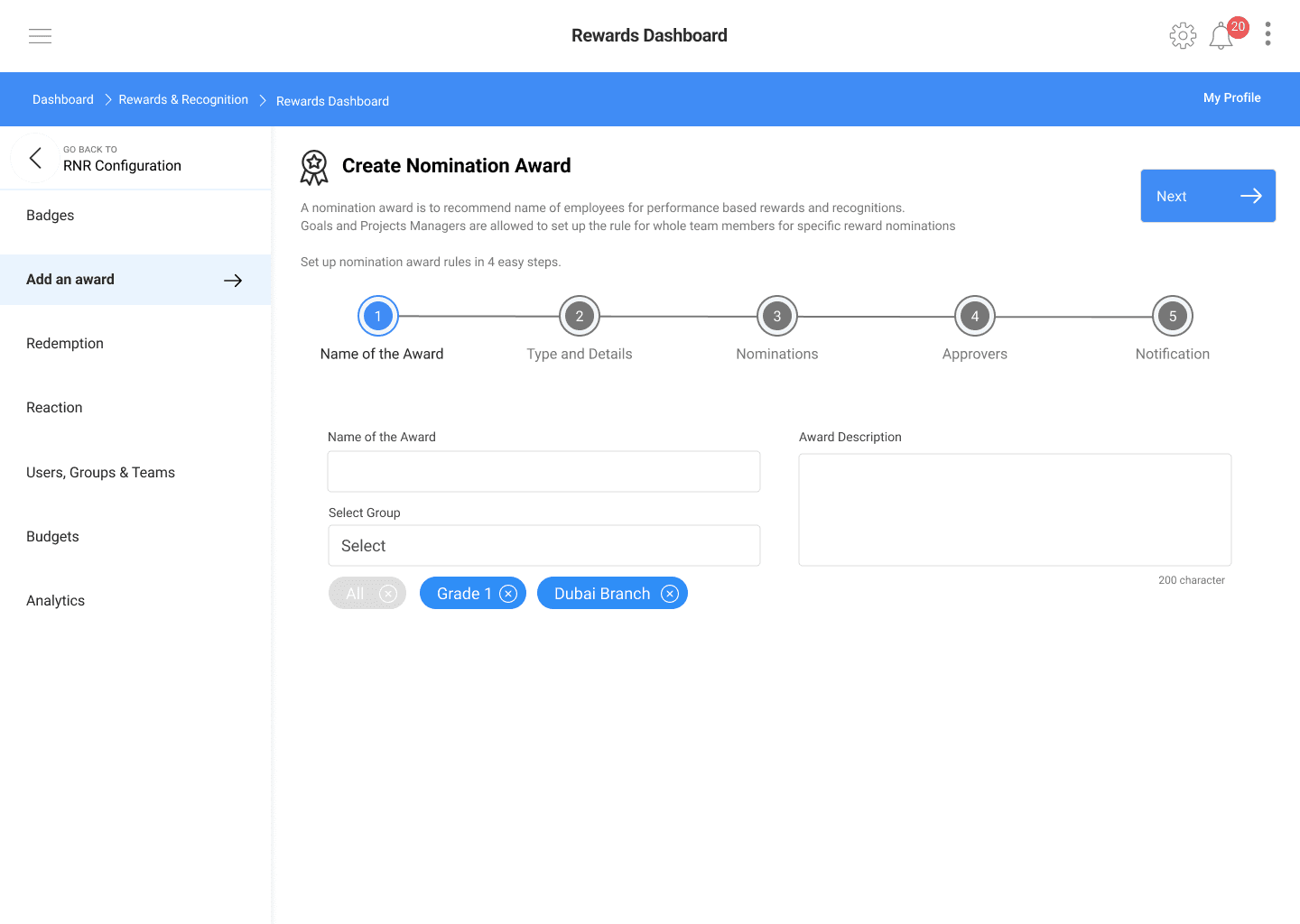
The solution was a group-based permission model. The admin could create groups sliced any way the organization needed: by location, by function, by team, or by any combination. Each award could then be assigned to one or more of these groups. This meant:
A location-based group could receive a region-specific award
A function-based group like all designers could be scoped to a specific nomination
A cross-functional team group could be nominated together regardless of reporting lines
This group-based model was a direct differentiator for enterprise customers who needed flexibility beyond a standard reporting hierarchy.
THE SOLUTION
The module was designed around six award types and four distinct user roles, each with a dedicated interface and workflow.
Award Types
Nomination-based awards
Value-based awards
Behavioral awards
Team-based awards
CEO On-Spot awards
Tenure-based awards
User Roles and Interfaces
Admin: configures badges, certificates, award types, groups, budgets, and the award calendar
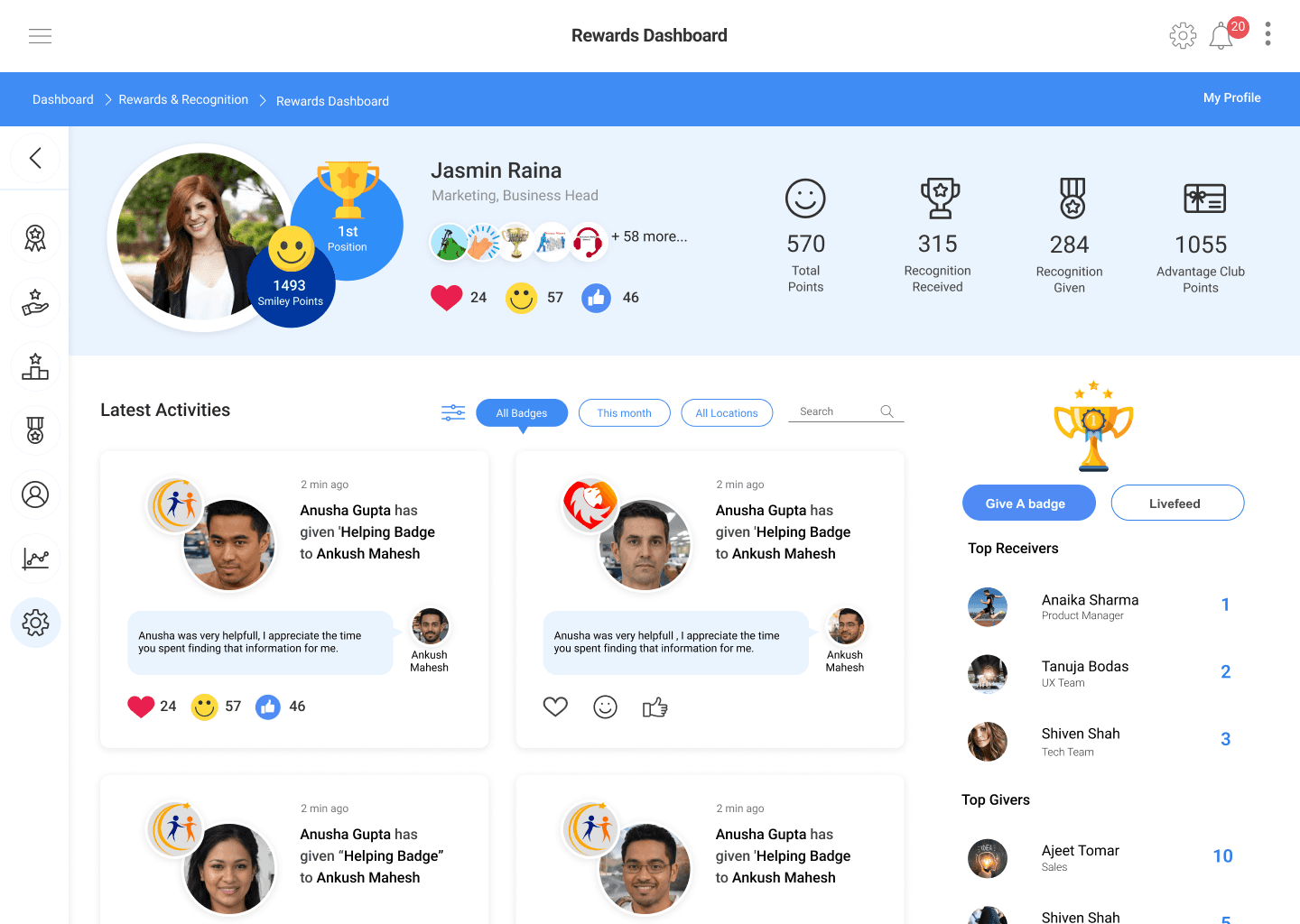
Regular Employee: personal dashboard showing received badges, points balance, activity feed, and company-wide leaderboard
Nominator (Manager, Product Owner, or Head of Product): nominates candidates within their group scope through a multi-step wizard
CHRO: final approver with full budget visibility, real-time spend tracking against budget, and notification customization
Key Features
Multi-step nomination and approval wizard consistent across all award types and all roles
Award Calendar with scheduling, deadline tracking, reminders, and region-level visibility
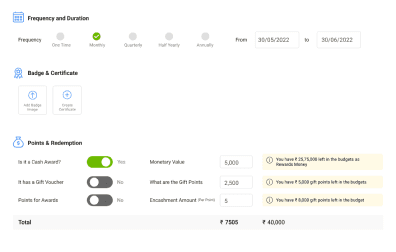
Budget management built into the CHRO approval flow with real-time spend tracking
Badge and certificate library for visual selection rather than text-based configuration
Advantage Club integration for external point redemption, giving employees tangible value outside the platform
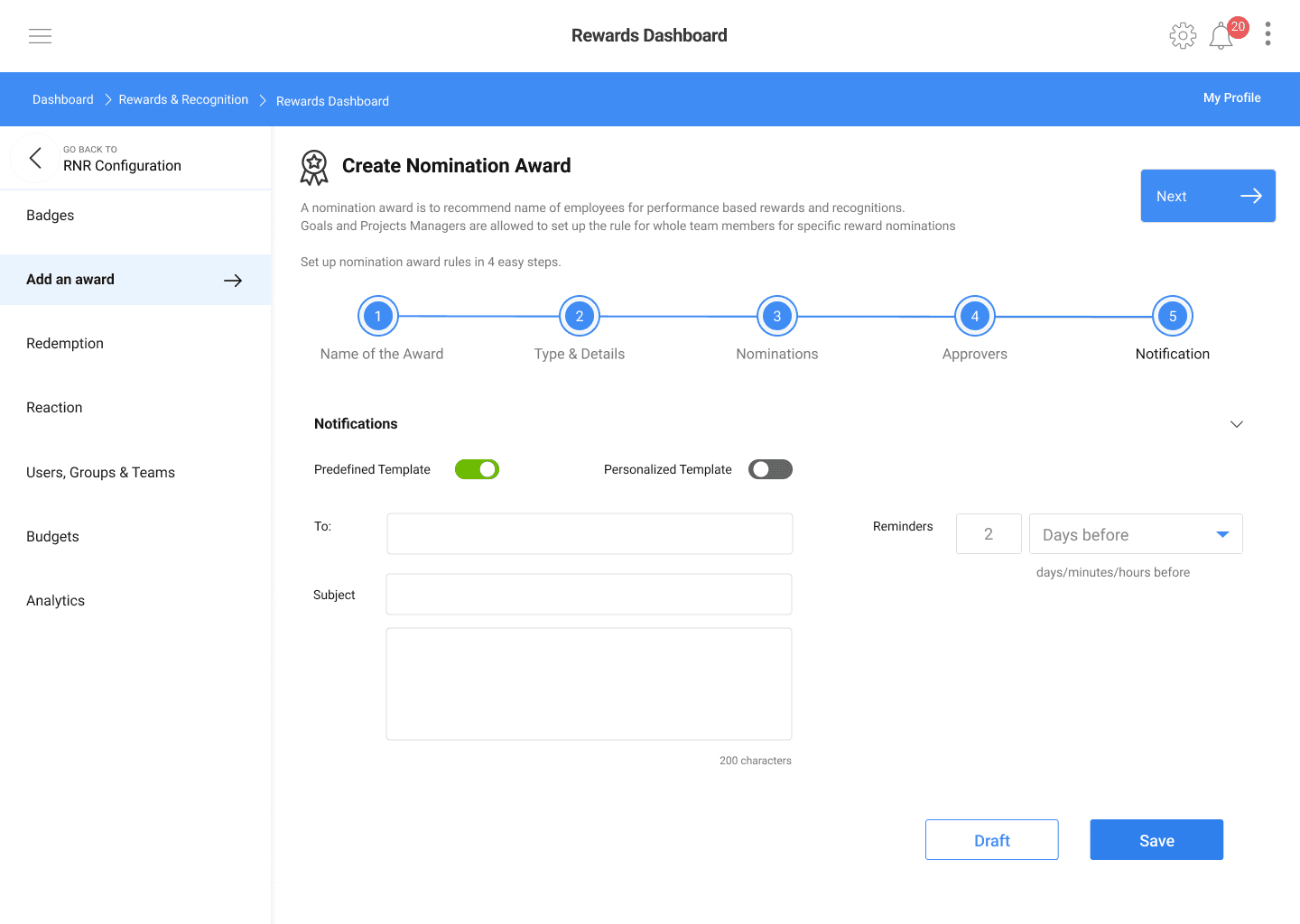
Notification customization at the end of every approval flow with predefined and personalized template options
Public recognition feed on the company dashboard and RNR landing page, making awards visible across the organization
MID-PROJECT PIVOT
IMPACT
How the Experience Improved
The module launched and was adopted across ZingHR's customer base, replacing an informal system of emojis and appreciations with a structured, auditable recognition workflow.
The most significant signal of the module's quality came after launch: the RNR module was selected as the foundation for a customized engagement with a large public sector enterprise client in India, one of the largest institutions of its kind in the country. That engagement required feature modifications and adaptations to suit the client's specific organizational structure, but the core architecture, permission model, and design system held.
Quantitative adoption metrics are being sought from the module owners.
Looking Back
Reflection